
Bible Verses About Being Reunited With Loved Ones In Heaven
May 5, 2025
Bible Verses About Uncertainty
May 8, 2025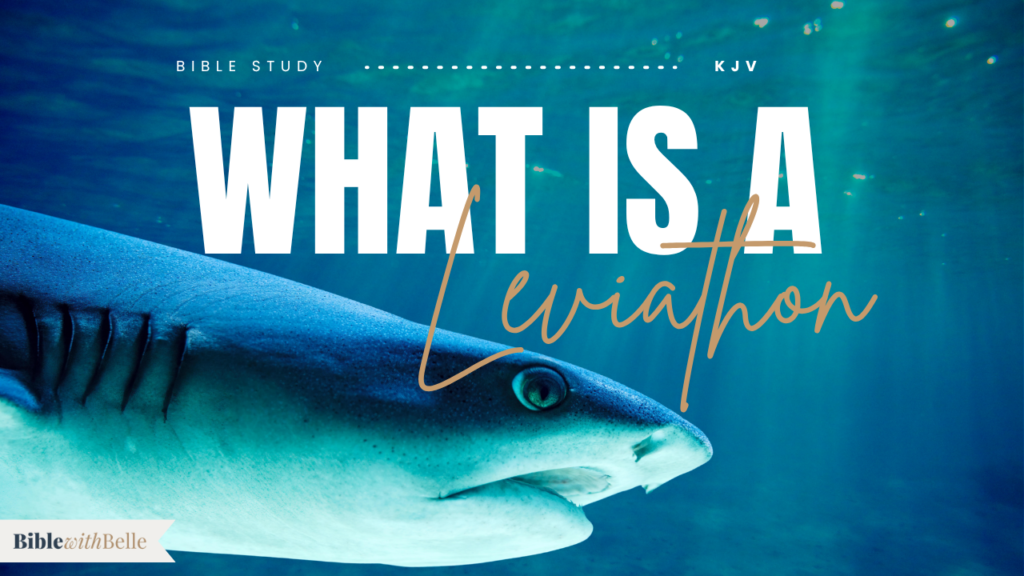
Leviathan is one of the most mysterious creatures mentioned in the Bible. It appears in several Old Testament passages, with the most detailed description found in Job 41.
The Bible describes Leviathan as extraordinarily powerful and frightening. In Job, God asks Job whether he can capture or control Leviathan, using the creature to demonstrate the vast difference between human power and God’s power. In Psalm 104, however, Leviathan is simply described as a creature that God made to live in the sea. In Isaiah 27, Leviathan appears in prophetic imagery as a serpent or dragon that God will ultimately destroy.
Because of these different passages, there has been considerable discussion about exactly what Leviathan was. Some understand it as a real sea creature, while others believe some of the biblical references use Leviathan as poetic or symbolic imagery.
The Bible itself does not give us enough information to identify Leviathan with certainty as a particular modern animal, dinosaur, dragon or demonic being.
What Scripture makes very clear, however, is that Leviathan is never God’s equal. God is its Creator, and God has authority over it.
Quick Answer: What Is Leviathan in the Bible?
Leviathan is a mysterious creature mentioned in Job 3:8, Job 41, Psalm 74:14, Psalm 104:26 and Isaiah 27:1.
The longest description is found in Job 41, where God describes Leviathan as a creature that humans cannot capture or control.
Job 41:1 — Can You Capture Leviathan?
“Canst thou draw out leviathan with an hook? or his tongue with a cord which thou lettest down?”
God’s question is meant to show Job the limitations of human strength.
Leviathan is presented as something beyond ordinary human control, yet God is completely aware of the creature and its power.
Psalm 104 gives us another important perspective: Leviathan is something God Himself made.
Psalm 104:25–26 — God Made Leviathan
“So is this great and wide sea, wherein are things creeping innumerable, both small and great beasts.
There go the ships: there is that leviathan, whom thou hast made to play therein.”
This means that whatever Leviathan was, Scripture presents it as part of God’s creation.
The creature may be terrifying to human beings, but it is not outside God’s authority.
Where Is Leviathan Mentioned in the Bible?
The word Leviathan appears in several Old Testament passages.
The main references are:
- Job 3:8
- Job 41
- Psalm 74:14
- Psalm 104:26
- Isaiah 27:1
These passages should be considered in their individual contexts because the biblical writers do not necessarily use Leviathan in exactly the same way each time.
Job gives us the most extensive description.
Psalm 104 presents Leviathan as part of God’s creation.
Psalm 74 uses Leviathan within imagery of God’s victory over powerful forces.
Isaiah 27 uses Leviathan imagery in a prophetic declaration of God’s judgment.
Job 41 Gives the Most Detailed Description of Leviathan
Job 41 is the central biblical passage concerning Leviathan.
The book of Job describes a man who has suffered tremendous loss and wants answers from God. Toward the end of the book, God speaks to Job and confronts him with questions about the created world.
God asks Job about animals and creatures whose power and complexity are beyond Job’s ability to control.
Leviathan is the climax of this discussion.
Job 41:1–8 — Leviathan Cannot Be Tamed
“Canst thou draw out leviathan with an hook? or his tongue with a cord which thou lettest down?
Canst thou put an hook into his nose? or bore his jaw through with a thorn?
Will he make many supplications unto thee? will he speak soft words unto thee?
Will he make a covenant with thee? wilt thou take him for a servant for ever?
Wilt thou play with him as with a bird? or wilt thou bind him for thy maidens?
Shall the companions make a banquet of him? shall they part him among the merchants?
Canst thou fill his skin with barbed irons? or his head with fish spears?
Lay thine hand upon him, remember the battle, do no more.”
The repeated questions make the point unmistakable.
Job cannot simply capture Leviathan, tame it, make it his servant or treat it as an ordinary animal.
God is showing Job something about the limits of human power.
Leviathan Was Terrifying to Human Beings
God continues describing Leviathan’s strength and the fear it inspires.
Job 41:9–11 — Who Can Stand Before God?
“Behold, the hope of him is in vain: shall not one be cast down even at the sight of him?
None is so fierce that dare stir him up: who then is able to stand before me?
Who hath prevented me, that I should repay him? whatsoever is under the whole heaven is mine.”
This is one of the most important parts of the entire passage.
God moves from discussing Leviathan to discussing Himself.
If human beings cannot stand against Leviathan, then who could possibly stand against God?
The answer is obvious.
God’s power is infinitely greater.
The final statement is particularly significant:
“whatsoever is under the whole heaven is mine.”
Leviathan is powerful.
But it belongs to God.
Leviathan’s Scales and Physical Strength
Job 41 continues with a remarkable description of Leviathan’s body.
Job 41:12–17 — Leviathan’s Scales
“I will not conceal his parts, nor his power, nor his comely proportion.
Who can discover the face of his garment? or who can come to him with his double bridle?
Who can open the doors of his face? his teeth are terrible round about.
His scales are his pride, shut up together as with a close seal.
One is so near to another, that no air can come between them.
They are joined one to another, they stick together, that they cannot be sundered.”
The description emphasises Leviathan’s strength and protection.
Its scales are described as tightly joined together, making the creature extremely difficult to penetrate or attack.
This is one reason Leviathan has generated so much speculation about its identity.
Some people believe the description could refer to an unusually powerful aquatic creature.
Others understand parts of the description as poetic imagery.
The important point is that Scripture does not give us a modern scientific classification for Leviathan.
Does Leviathan Breathe Fire?
Perhaps the most unusual part of Job 41 is the description of fire and smoke.
Job 41:18–21 — Fire and Smoke
“By his neesings a light doth shine, and his eyes are like the eyelids of the morning.
Out of his mouth go burning lamps, and sparks of fire leap out.
Out of his nostrils goeth smoke, as out of a seething pot or caldron.
His breath kindleth coals, and a flame goeth out of his mouth.”
These verses have led to many theories about Leviathan.
Some readers believe this must describe an extraordinary creature unknown to us today.
Others believe the language is highly poetic and is intended to communicate the terrifying power of the creature rather than provide a scientific description.
We should be careful not to turn either interpretation into a biblical certainty.
The Bible says what Leviathan is like in this passage. It does not tell us that Leviathan was a dinosaur or a fire-breathing dragon.
Was Leviathan a Dinosaur?
Some Christians believe Leviathan may have been a dinosaur or another prehistoric creature.
The unusual description in Job 41 is often used to support this idea.
However, the Bible never says that Leviathan was a dinosaur.
Therefore, it is better to present this as an interpretation rather than as a fact.
The biblical text gives us a description of Leviathan, but it does not provide the scientific information necessary to identify it with a particular extinct species.
Was Leviathan a Crocodile?
Another interpretation is that Leviathan may have been a crocodile or another large aquatic creature.
Some aspects of Job 41 can certainly sound similar to a powerful aquatic predator: its scales, teeth, strength, ability to live in the water and difficulty being captured.
However, other parts of the description are more difficult to reconcile with an ordinary crocodile, particularly the imagery of fire and smoke.
For this reason, it is best not to say that Leviathan definitely was a crocodile.
It is one possible interpretation.
Was Leviathan Satan?
Another popular interpretation is that Leviathan represents Satan.
This idea is sometimes connected to Isaiah 27:1, where Leviathan is described as a crooked serpent and a dragon in the sea.
Isaiah 27:1 — God Will Defeat Leviathan
“In that day the Lord with his sore and great and strong sword shall punish leviathan the piercing serpent, even leviathan that crooked serpent; and he shall slay the dragon that is in the sea.”
The imagery certainly sounds like a powerful enemy being defeated by God.
However, the Bible never directly says that Leviathan is Satan.
That distinction matters.
We should not take a possible symbolic connection and present it as though Scripture explicitly teaches it.
The safest conclusion is that Leviathan imagery can communicate God’s victory over powerful forces opposed to Him, particularly in poetic and prophetic passages.
Psalm 74 Shows God’s Victory Over Leviathan
Psalm 74 contains another significant reference.
The psalm remembers God’s mighty acts in creation and His deliverance of His people.
Psalm 74:12–14 — God Broke the Heads of Leviathan
“For God is my King of old, working salvation in the midst of the earth.
Thou didst divide the sea by thy strength: thou brakest the heads of the dragons in the waters.
Thou brakest the heads of leviathan in pieces, and gavest him to be meat to the people inhabiting the wilderness.”
The language here is very different from Psalm 104.
Psalm 104 presents Leviathan as something God made.
Psalm 74 uses Leviathan within dramatic imagery of God’s power over the sea and His enemies.
This is one reason we should be cautious about trying to force every reference to Leviathan into exactly the same interpretation.
The larger message of Psalm 74 is that God is King and has power over everything that appears chaotic, dangerous or opposed to Him.
Psalm 104 Shows Leviathan as God’s Creation
Psalm 104 gives us perhaps the most important verse for understanding Leviathan’s relationship with God.
Psalm 104:24–26 — Leviathan Belongs to God’s Creation
“O Lord, how manifold are thy works! in wisdom hast thou made them all: the earth is full of thy riches.
So is this great and wide sea, wherein are things creeping innumerable, both small and great beasts.
There go the ships: there is that leviathan, whom thou hast made to play therein.”
The context is praise.
The psalmist is looking at God’s creation and declaring how wonderfully God has made it.
Leviathan appears among the creatures of the sea.
This is significant because it reminds us that Leviathan is not an independent power competing with God.
God made it.
The creature that appears so frightening in Job is still a creature.
God is the Creator.
Why Does the Bible Mention Leviathan?
The Bible’s purpose in mentioning Leviathan is not simply to satisfy our curiosity about mysterious creatures.
The references to Leviathan point us toward larger truths about God.
In Job, Leviathan demonstrates the limitations of human power.
In Psalm 104, Leviathan demonstrates the variety and wisdom of God’s creation.
In Psalm 74, Leviathan appears within imagery of God’s victory.
In Isaiah 27, Leviathan appears in a prophecy of God’s ultimate judgment.
The common thread is that God is greater.
Leviathan Shows How Great God’s Power Is
Job 41 is especially important because God uses Leviathan to challenge Job’s understanding.
Job had been suffering and had questions about God’s dealings with him.
God did not give Job a simple explanation for every detail.
Instead, God revealed His greatness.
Job 41:10–11 — Nothing Is Beyond God’s Authority
“None is so fierce that dare stir him up: who then is able to stand before me?
Who hath prevented me, that I should repay him? whatsoever is under the whole heaven is mine.”
This is ultimately the point.
If something as powerful as Leviathan is still under God’s authority, then God has not somehow lost control simply because Job cannot understand what is happening.
Sometimes we want God to explain everything.
But Scripture teaches us that we can trust God even when we do not have every answer.
Leviathan and the Mystery of God’s Creation
There are many things in God’s creation that human beings do not completely understand.
Job itself repeatedly reminds us of the limitations of human knowledge.
Leviathan fits within that larger theme.
We can study the description.
We can compare interpretations.
We can discuss whether it describes a real animal, poetic imagery or something more mysterious.
But ultimately, we should be comfortable acknowledging what Scripture does not tell us.
Not every mystery in the Bible has to be solved before we can understand its spiritual message.
God Is Greater Than What Frightens Us
Leviathan was portrayed as something humans could not control.
That makes the passage meaningful beyond the question of the creature’s identity.
There are circumstances in our own lives that can feel uncontrollable.
We may face situations that are frightening, confusing or completely beyond our ability to fix.
The lesson of Job 41 is not that Christians will never face frightening circumstances.
It is that God remains greater than anything we encounter.
Psalm 46:1–2 — God Is Our Refuge
“God is our refuge and strength, a very present help in trouble.
Therefore will not we fear, though the earth be removed, and though the mountains be carried into the midst of the sea;”
Our confidence does not have to come from having perfect circumstances.
It can come from knowing the God who remains present in the middle of them.
Leviathan Reminds Us That God Is the Creator
Psalm 104 is particularly helpful because it takes something mysterious and frightening and places it within the larger story of creation.
God made the seas.
God made the creatures in them.
God made Leviathan.
And God’s creation remains under His authority.
Psalm 104:31 — God’s Works Bring Him Glory
“The glory of the Lord shall endure for ever: the Lord shall rejoice in his works.”
The focus ultimately returns to God.
The creature is interesting.
The Creator is greater.
Bible Verses About Leviathan
If you are looking for the main Bible verses about Leviathan, these are the passages to study carefully.
Job 3:8 — Leviathan and Job’s Grief
“Let them curse it that curse the day, who are ready to raise up their mourning.”
Job mentions Leviathan while expressing the depth of his anguish over the day of his birth.
Job 41:1 — Can You Capture Leviathan?
“Canst thou draw out leviathan with an hook? or his tongue with a cord which thou lettest down?”
This begins the Bible’s most extensive description of Leviathan.
Psalm 74:14 — God Breaks the Heads of Leviathan
“Thou brakest the heads of leviathan in pieces, and gavest him to be meat to the people inhabiting the wilderness.”
The passage occurs within a larger celebration of God’s power and His mighty acts.
Psalm 104:26 — God Made Leviathan
“There go the ships: there is that leviathan, whom thou hast made to play therein.”
This verse explicitly identifies Leviathan as something God made.
Isaiah 27:1 — God Will Destroy Leviathan
“In that day the Lord with his sore and great and strong sword shall punish leviathan the piercing serpent, even leviathan that crooked serpent; and he shall slay the dragon that is in the sea.”
This passage presents Leviathan within prophetic imagery of God’s judgment and victory.
What Does Leviathan Teach Us About God?
The most important lesson of Leviathan is not about the creature itself.
It is about God’s greatness.
Job was confronted with something he could not control.
God was not.
Job was confronted with something he could not fully understand.
God understood it.
Job could not see the whole picture of his circumstances.
God could.
This is why the Leviathan passage is so powerful in the book of Job.
God does not need to give us complete explanations before He is worthy of our trust.
Job 42:2 — God Can Do All Things
“I know that thou canst do every thing, and that no thought can be withholden from thee.”
By the end of the book, Job’s response demonstrates that he has come to recognise God’s greatness in a deeper way.
The answer to Job’s suffering was not simply an explanation.
It was a greater understanding of God Himself.
Is Leviathan the Same as the Dragon in Revelation?
No. The Bible does not explicitly identify Leviathan with the dragon in Revelation.
The New Testament uses the image of a dragon when describing Satan, but that does not mean that every Old Testament reference to Leviathan is automatically referring to Satan.
Revelation 20:2 — The Dragon Is Identified as Satan
“And he laid hold on the dragon, that old serpent, which is the Devil, and Satan, and bound him a thousand years.”
This passage explicitly identifies the dragon as Satan.
Isaiah 27:1, meanwhile, calls Leviathan a serpent and dragon-like creature.
There is clearly imagery that Christians have connected across these passages, but we should distinguish biblical connections from statements the Bible explicitly makes.
Should Christians Be Afraid of Leviathan?
No.
There is no biblical reason for a Christian to live in fear of Leviathan.
The Bible does not present Leviathan as a supernatural power that Christians need to fight or fear today.
Instead, the passages point toward God’s sovereignty.
Psalm 56:3 — Trust God When You Are Afraid
“What time I am afraid, I will trust in thee.”
The principle is simple.
When something frightens us, our attention should ultimately turn toward God.
Final Thought
Leviathan is one of the Bible’s most fascinating mysteries.
We can debate what kind of creature Job 41 describes.
We can consider whether the imagery points to a real sea creature, poetic imagery or something more symbolic.
But we should not allow speculation to become more important than Scripture itself.
The Bible’s central message is much clearer than the identity of Leviathan.
God is greater.
Leviathan cannot be controlled by human beings, but it is still God’s creature.
The sea may appear chaotic, but God rules over it.
Powerful forces may appear impossible for us to overcome, but they are not beyond God’s authority.
And when we encounter circumstances that we cannot understand, we can remember what God showed Job.
Job 41:10–11 — Everything Under Heaven Belongs to God
“None is so fierce that dare stir him up: who then is able to stand before me?
Who hath prevented me, that I should repay him? whatsoever is under the whole heaven is mine.”
That is the heart of the Leviathan passages.
They are ultimately not about making us obsessed with a mysterious creature.
They are about putting God’s greatness into perspective.
We may not understand everything God has created.
We may not understand everything God is doing.
We may not be able to control everything that happens around us.
But we can know who is in control.
God is the Creator, and nothing under heaven is greater than Him.
✨ Still Have a Question?
You can send it through the Ask a Bible Question page, and I’ll respond with guidance from God’s Word.
You can also leave your questions on my YouTube channel. This is where I regularly share Bible verses, encouragement, and answers to common questions.